Hill's Science Plan Light Adult Wet Dog Food is a complete premium pet food for adult dogs that tend to gain weight easily. This deliciously smooth loaf is formulated to deliver the appropriate amount of energy to support weight maintenance in adult dogs.
Precisely balanced nutrition with Hill's ActivBiome+ prebiotic blend actively contributes to supporting digestive health and overall wellbeing to help your pet feel their best
Hill's Science Plan Large Breed Adult Dog Food with Lamb & Rice is a complete pet food, specially formulated with ActivBiome+ Multi-Benefit Technology.
This food is specifically designed to fuel the energy needs of large breed dogs during the prime of their life.
Hill's Science Plan CULINARY CREATIONS Adult cat food with Salmon & Carrots was formulated to provide a great-tasting experience to cats. Its delicious flavour and texture are combine with essential nutrients to support cats' optimal health during the prime time of their life. Specially formulated with high-quality salmon protein, essential taurine for heart health & balanced minerals to support kidneys & bladder.
Hill's Science Plan Senior Vitality Cat Food with Chicken & Rice provides precisely balanced nutrition that helps promote their everyday ability to get up and go.
Hill's Science Plan Adult Cat Food with Chicken is a complete pet food, specially formulated with ActivBiome+ Multi-Benefit Technology.
This food is specially formulated to fuel the energy needs of cats during the prime of their life.
The government has announced that as of April 2016, all dogs in the UK must be microchipped by law.
In people, the right diet is very important. If you are eating the wrong way for your metabolism, activity level, age and lifestyle you could end up with health issues.
Learn what your pet's microbiome is, how it contributes to your pet's gut and overall health, and why nutrition is important in maintaining healthy microbiomes.
A digestive (or GI) disorder is any health situation that prevents your cat from properly digesting food, or alters the rate that food passes through their digestive tract. Don't ignore the signs! If your furry friend is showing symptoms of digestive disorders, seek immediate advice from your veterinarian.
The most common signs of cat stomach problems and digestive disorders are soft stools or diarrhoea. You may also notice some or all of the following signs in your cat.
Digestive upsets can happen for a variety of reasons, and all of them can make your cat feel under the weather. Remember, that diarrhoea can be difficult to spot in cats that toilet outside. If you suspect your cat is having issues it’s worth providing a litter tray so that you can see what’s going on. Below are some of the more common digestive problems we see in cats.
This is the most common cause of an ‘upset stomach’ in cats. It usually consists of vomiting and diarrhoea that begins suddenly. It can be caused by lots of things like eating something unsavoury (or as many cats love to do, eating half a mouse and leaving the rest for us to find!), parasites, viruses and hairballs, to name but a few.
Unlike the sudden onset upset we just mentioned, chronic enteropathies are slower to appear and tend to last a long time. Diarrhoea and weight loss are common signs. Again, it can be caused by many different things such as adverse food reactions, immune reactions and genetics.
The colon is part of the large bowel and when this gets inflamed it’s called colitis. It’s usually very characteristic and most cats show the same signs - looking like they urgently need to have a poop, they might strain to have a poo but not much comes out, and one of the classic signs of colitis is fresh blood and/or slimy mucus in the stools.
For more detailed information, read this article on colitis in cats
The same as in humans, when cats are constipated, they find pooping difficult and they might go to the toilet much less frequently. Constipation can be caused by lots of things. Eating bones, feathers and fur can make the stools hard and difficult to pass, the presence of lots of hair, especially in long-haired cats or a sluggish bowel will also mean that the stools are dry and difficult to shift. Some breeds like the Siamese are more prone to a sluggish bowel than others. This can result in a condition called megacolon.
For more insights, visit this detailed article on cat constipation
This is a complex condition in cats and can be difficult to diagnose with vague signs. These signs include vomiting, lethargy and lack of appetite. As detailed in this article on pancreatitis in cats, it can seem to come and go and often goes hand in hand with other problems like adverse food reactions and inflammatory bowel disease.
Cats can react badly to certain foods for a number of reasons and together we call these adverse food reactions. True food allergies are rarer than people think and they tend to be caused by proteins in foods such as chicken, fish and milk. Food allergies can cause vomiting and diarrhea and also skin issues like itchiness and excessive grooming. For more on managing a cat with a sensitive stomach, see this detailed article.
First, if you suspect your cat is suffering from a digestive disorder, talk to your vet about treatments that may be able to help. You can further help your cat by helping reduce the amount of stress triggers in their environment with some of these suggestions.
Changes to your furry friend’s environment or routine can lead to GI upset. Providing your cat with a calm, safe environment – as well as some regular playtime – can help your cat’s anxiety.
Parasites like roundworms and hookworms can caus GI issues, so if your cat tends to explore the outdoos, make sure they have the proper preventative care.
Foods made with highly digestible ingredients can be gentle on upset tummies. Ask your veterinarian about switching your cat’s food and how to do it without upsetting your cat’s stomach any further.
First, if you suspect your cat is suffering from a digestive disorder, talk to your vet about treatments that may be able to help. You can further help your cat by helping reduce the amount of stress triggers in their environment with some of these suggestions.
Changes to your furry friend’s environment or routine can lead to GI upset. Providing your cat with a calm, safe environment – as well as some regular playtime – can help your cat’s anxiety.
Parasites like roundworms and hookworms can caus GI issues, so if your cat tends to explore the outdoos, make sure they have the proper preventative care.
Foods made with highly digestible ingredients can be gentle on upset tummies. Ask your veterinarian about switching your cat’s food and how to do it without upsetting your cat’s stomach any further.
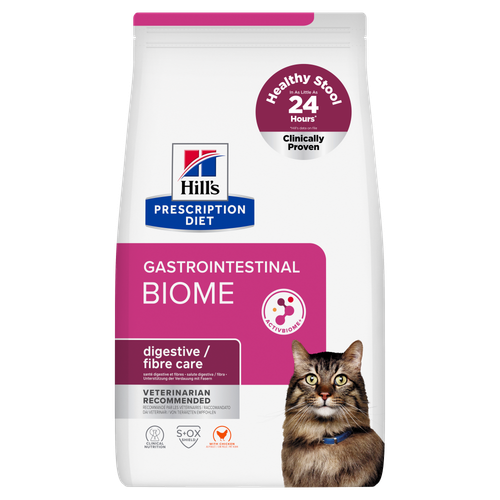
Hill’s Prescription Diet Gastrointestinal Biome Stress Dry Cat Food is great-tasting nutrition in a proprietary formula that helps reduce stress for cats that have digestive upsets. Clinical nutrition formulated with high fibre to promote regular healthy stools in as little as 24 hours. Made with ActivBiome+ ingredient technology to quickly nourish the gut microbiome and help manage complex GI issues. Made with added ingredients to help reduce stress.
Hill’s Prescription Diet Gastrointestinal Biome is a high-fibre dry cat food clinically shown to promote regular healthy stool in as little as 24 hours and help reduce risk of recurrence. Made with ActivBiome+ Ingredient Technology to rapidly nourish the gut microbiome and help manage complex GI issues.
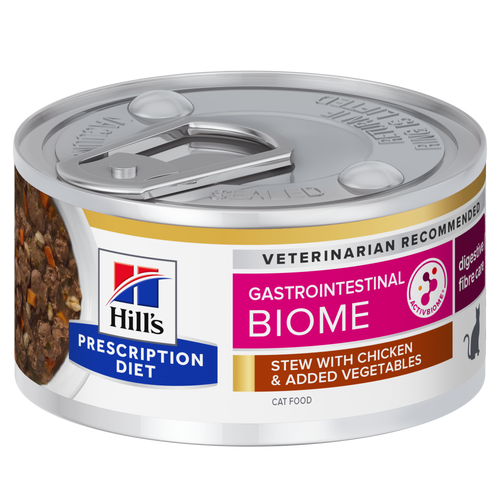
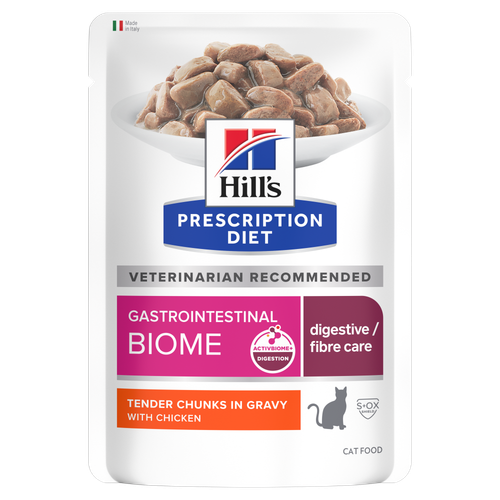
Hill’s Prescription Diet Gastrointestinal Biome Stress Wet Cat Food is great-tasting nutrition in a proprietary formula that helps reduce stress for cats that have digestive upsets. Clinical nutrition formulated with high fibre to promote regular healthy stools in as little as 24 hours. Made with ActivBiome+ ingredient technology to quickly nourish the gut microbiome and help manage complex GI issues. Made with added ingredients to help reduce stress.
Hill's Prescription Diet Gastrointestinal Biome is a high-fibre wet cat food clinically shown to promote regular healthy stool in as little as 24 hours and help reduce risk of recurrence. Fortified with ActivBiome+ Ingredient Technology to rapidly nourish the gut microbiome and help manage complex GI issues.
Explore our guide to the pros and cons of wet and dry cat food to find what's best for your cat's needs. For expert nutritional guidance, visit Hill's Pet.
Discover what you can do to spot and support a sensitive cat stomach. See what routines and food you can implement to help your cat be happy and healthy.
Find out about how you can support your cat's digestion to boost overall health. Diet is key to a long and happy life for your cat, so discover what you can do.
Learn why fibre is so important for your cat's diet and health. Explore the key benefits and advantages for cat gut health. See more at Hill's Pet UK.